


The most powerful collection of public monuments in America — all free, all extraordinary, and all within walking distance of each other. This is where the history you learned in school becomes something you can stand in front of.
Washington D.C.’s monuments and memorials are among the most visited sites in the world — and every single one of them is free to visit, open almost every day of the year, and accessible to anyone who makes the walk. Spread across the National Mall and its surrounding parkland, they form one of the great public spaces in any city on earth.
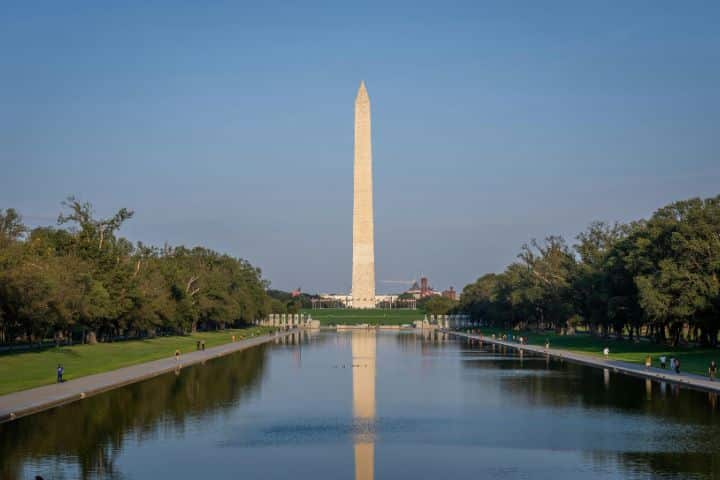
What makes D.C.’s monuments genuinely remarkable isn’t just what they commemorate, but how they feel in person. The Lincoln Memorial at dawn with no one else around. The Vietnam Veterans Wall at dusk, when visitors press paper to names. The Washington Monument framed in the Reflecting Pool. These are experiences that photographs prepare you for but don’t quite capture — and they’re all available to anyone who shows up.
One of the most recognized landmarks in the world, and one of the most powerful to stand inside. Lincoln sits at the west end of the Mall looking toward the Capitol, and the steps leading up to him are where Martin Luther King Jr. delivered the “I Have a Dream” speech in 1963. The inscription is marked on the landing. Visit at first light for an experience that is quietly unforgettable — the chamber is yours, the city is still, and the scale of the thing becomes real in a way it doesn’t in the afternoon crowds.
At 555 feet, the Washington Monument remains the tallest stone structure in the world and the centerpiece of the National Mall. The views from the top are extraordinary — the Mall in both directions, the Capitol, the White House, and the Potomac beyond. Passes are required to go up and should be reserved in advance on the National Park Service website (free, but they go fast). Even from the base, the scale of the obelisk is something you have to see in person to fully grasp.
Maya Lin’s design — two black granite walls descending into the earth, inscribed with the names of the 58,000 Americans who died in the Vietnam War — remains one of the most affecting pieces of public art ever created. The wall reflects the sky, the trees, and the faces of visitors looking for a name. Pencil rubbings are made every day, by family members who have been coming for decades. It does not matter what you know about the war before you go — the wall changes something in most people who visit it.
Situated at the east end of the Reflecting Pool between the Lincoln Memorial and the Washington Monument, the WWII Memorial honors the 16 million Americans who served and the 400,000 who died. The memorial’s 56 pillars represent each state and territory, and the Field of Stars — 4,048 gold stars on the Freedom Wall — represents the 400,000 American deaths. It’s a quieter experience than many visitors expect, and often deeply moving for anyone with family connections to the war.
Opened in 2011 on the north bank of the Tidal Basin, the MLK Memorial features a 30-foot granite statue of Dr. King emerging from a boulder, with inscriptions from his speeches carved along the curved inscription wall. The site is peaceful and beautifully positioned — in spring, cherry blossoms frame the view across the water. The location between the Lincoln and Jefferson Memorials is intentional, reflecting Dr. King’s place in the American story. The inscription wall selections are worth reading in full.
The neoclassical rotunda on the south shore of the Tidal Basin houses a 19-foot bronze statue of Thomas Jefferson, surrounded by excerpts from the Declaration of Independence and his other writings. The Jefferson Memorial is one of the most elegant structures in the city, and its position on the Tidal Basin makes it one of the most photographed — especially during cherry blossom season. The walk around the Basin from the MLK Memorial is one of D.C.’s great short walks, in any season.
Often overlooked in favor of its more famous neighbors, the Korean War Veterans Memorial is one of the most haunting on the Mall. Nineteen stainless steel statues of soldiers move through juniper bushes as if on patrol, their ponchos catching the wind in the artist’s rendering. The mural wall alongside them reflects additional soldiers in the polished granite. It’s a profoundly different kind of memorial — kinetic, unsettling, and hard to forget.
Based on Joe Rosenthal’s iconic photograph of Marines raising the flag on Iwo Jima, this 78-foot bronze memorial just across the river in Arlington is one of the largest cast bronze statues in the world. The flag flies 24 hours a day, 365 days a year by presidential proclamation. Its location near Arlington National Cemetery makes it a natural pairing — the walk between the two, through the hills above the Potomac, is one of the most quietly moving in the region.
Practical details to help you make the most of your time on the Mall.
Local knowledge that makes a monuments visit genuinely memorable.
Go before 8am. The National Mall in the early morning is one of D.C.’s great experiences — joggers, quiet, and a light that photographers chase. Most tourists arrive after 10am.
Book Washington Monument passes in advance. They’re free but limited — reserve them at recreation.gov as soon as your trip is confirmed. Walk-up passes are sometimes available at the monument but not guaranteed.
The Korean War Memorial at night is not to be missed. The illuminated figures are haunting in a way that daytime simply doesn’t convey. It’s a 5-minute detour from the Lincoln Memorial and completely different after dark.
Don’t underestimate the walk. The Mall is 1.9 miles end to end. A comfortable pace for seeing everything from the Capitol to the Lincoln Memorial is 3–4 hours. Wear shoes you’d walk a half marathon in.
The Tidal Basin walk connects Jefferson, MLK, and FDR. A circuit around the Basin is one of D.C.’s best short walks — about 2 miles, three major memorials, and in spring, the city’s most famous cherry blossom views.
Rangers make the difference. National Park Service rangers are stationed at most monuments from 9:30am to 10pm and offer free informal talks throughout the day. Ask one a question — they know things the plaques don’t tell you.
We’ve been taking guests to the monuments for fifteen years, and the question we hear most afterward is: “Why didn’t I come earlier?” Early morning on the National Mall — with the mist still on the Reflecting Pool, the Lincoln Memorial catching the first light, and almost no one else around — is one of the genuinely great free experiences in America. Our properties in Capitol Hill and Logan Circle are a short walk or bike ride from the Mall. Set your alarm, pack a thermos, and go before the tour buses arrive.
Stay close to the monuments
Our Capitol Hill and Logan Circle rentals put you within walking distance of the National Mall — the perfect base for early morning visits before the crowds arrive.