


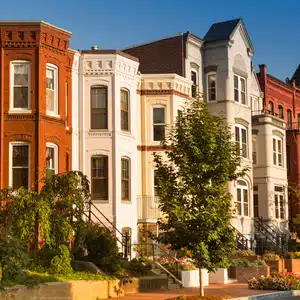
The version of D.C. that most visitors miss is the one that exists between the monuments: rowhouse blocks, corner markets, alley gardens, local coffee shops, and the particular atmosphere of neighborhoods that have been built and rebuilt over two centuries. These walks take you there.
Washington D.C. was designed for walking, with diagonal avenues cutting across a grid of streets that creates a series of circles, squares, and small parks at regular intervals throughout the city. The result is a city that reveals itself gradually and rewards slow, attentive movement through its neighborhoods in a way that few American cities manage. The monuments and museums are extraordinary, but they are also the part of D.C. that every visitor already knows. The neighborhoods are the part that most visitors leave without ever seeing.
The walks on this page are organized around the neighborhoods where our properties are located, and the districts that are most naturally reached from them on foot. Each one can be done in a morning or afternoon at a relaxed pace, with stops for coffee, lunch, or a browse along the way. None of them require a guide or a plan beyond the general direction of travel. The best neighborhood walks in D.C. are the ones where you allow yourself to get slightly lost and then find your way back.
Capitol Hill is one of the most beautiful and historically intact residential neighborhoods in America, and most of the people who pass through on a tour bus to see the Capitol never walk the surrounding streets. The Hill extends well beyond the government buildings at its center, into a dense residential grid of Victorian rowhouses, corner shops, church steeples, and alley gardens that has changed less than almost any other part of D.C. over the past century. The walk from the Capitol grounds east along East Capitol Street to Lincoln Park, then south along 11th Street to the Eastern Market, covers the neighborhood’s best residential blocks and ends at one of the city’s great public markets. The side streets off Pennsylvania Avenue SE, particularly along Seward Square and Marion Park, are among the finest blocks of rowhouse architecture in D.C. Allow extra time on Saturday mornings when the Eastern Market flea is in full operation.
We have properties in Capitol Hill. Explore the neighborhood ›
U Street was known as Black Broadway before and during the era of segregation, home to jazz clubs, theaters, newspapers, and institutions that made it the cultural center of African American life in Washington. Duke Ellington was born in this neighborhood. The Howard Theatre hosted Ella Fitzgerald and Marvin Gaye. Ben’s Chili Bowl opened in 1958 and never closed. Walking along U Street from 9th Street to 14th Street, then south through Shaw toward Blagden Alley and the 9:30 Club, covers the geography of that history alongside the restaurants, bars, and new buildings that have arrived in the last two decades. The African American Civil War Memorial at 10th and U is a moving stop along the way, and the Howard Theatre, still operating as a concert venue, is worth pausing at even if nothing is scheduled. The walk ends naturally at 14th Street, where dinner options are exceptional.
We have properties in Shaw. Explore the neighborhood ›
Logan Circle is one of D.C.’s most architecturally distinguished neighborhoods, with 135 late Victorian rowhouses surrounding a formal landscaped circle that is listed on the National Register of Historic Places. The eight-block Historic District contains some of the finest domestic architecture in the city, built in the 1880s and 1890s when the neighborhood was home to Washington’s professional class. Walking the streets around the circle, then north along 13th Street to the corner shops and cafes, then east along Rhode Island Avenue to the P Street corridor, reveals a neighborhood that manages to be both historic and genuinely alive. The concentration of restaurants along 14th Street between P Street and Florida Avenue, within easy walking distance of the circle, makes Logan Circle one of the best bases in the city for an evening that starts on foot and ends at a dinner table.
We have properties in Logan Circle. Explore the neighborhood ›
Dupont Circle rewards a slow walk in almost any direction. The circle itself is one of D.C.’s great public spaces, shaded and animated by chess players, dog walkers, and a steady stream of neighborhood residents. Walking north on Massachusetts Avenue toward the Naval Observatory puts you on Embassy Row, where the official residences and chanceries of over 50 countries line both sides of the avenue in buildings that range from Georgian mansions to Modernist concrete. The walk south from the circle through the streets toward downtown passes some of the most significant Gilded Age domestic architecture in the city. Connecticut Avenue between the circle and Woodley Park is the neighborhood’s main commercial street, with independent restaurants, Kramerbooks, and the Sunday FreshFarm Market on 20th Street making it the right place to spend a Sunday morning.
We have properties in Dupont Circle. Explore the neighborhood ›
Georgetown predates Washington D.C. itself, established as a Maryland port town in 1751, and the streets reflect that age in a way that most of the planned capital cannot match. The residential blocks north of M Street, particularly O Street, P Street, and the streets around Dumbarton Oaks, contain some of the finest Federal and Georgian domestic architecture in America, lived in and maintained by Georgetown University faculty, diplomats, and the city’s oldest families. Walking down from the residential heights to the waterfront along the C&O Canal towpath connects the neighborhood’s history as a working port to its present as one of D.C.’s most beautiful urban walks. The Georgetown waterfront itself, with its views across the Potomac to Virginia, is a natural stopping point for lunch before heading back through the shopping streets on Wisconsin Avenue and M Street. The Key Bridge connection to the Virginia side and the Mount Vernon Trail is worth knowing for cyclists.
Adams Morgan is D.C.’s most international neighborhood and one of its most alive at street level, with 18th Street functioning as an outdoor social corridor lined with Ethiopian, Ethiopian, Latin American, Caribbean, and American restaurants, bars, and late-night venues. The neighborhood sits on a ridge above Columbia Road, and the walk up from Dupont Circle along Connecticut Avenue and across to 18th Street passes through a residential transition that reflects D.C.’s layered immigration history. Tryst coffee shop, Songbyrd record cafe, and a string of independently owned restaurants make this one of the best walking neighborhoods in the city for an evening that doesn’t follow a fixed plan. The Columbia Road farmers market on Saturdays is one of D.C.’s most genuinely multicultural public spaces, worth an early start before the evening crowds arrive.
How to walk D.C.’s neighborhoods well.
The alleys are worth finding. D.C.’s residential neighborhoods have a network of named alleys behind the rowhouses, many of which contain small carriage houses, garden spaces, and architectural details that are completely invisible from the street. Blagden Alley in Shaw and the alleys of Capitol Hill are particularly worth exploring.
Early morning is when the neighborhoods are most themselves. Before 9am, D.C.’s residential blocks belong to their residents, not their visitors. The light is better, the streets are quieter, and the coffee shops are run by the people who live there. This is the version of the neighborhood worth seeing.
Embassy Row can be walked at any time. Massachusetts Avenue between Dupont Circle and the Naval Observatory is lined with the official residences and chanceries of more than 50 countries. The architecture is extraordinary and it is a public street, entirely walkable without a ticket or reservation.
The neighborhood churches are often unlocked and worth entering. D.C.’s historic neighborhoods contain some of the finest church architecture in America, ranging from the National Cathedral down to neighborhood Baptist churches that have anchored their communities since before the Civil War. Many are open during the day and free to enter.
Staying in the neighborhood means the walk starts at the front door. One of the genuine advantages of a vacation rental in Shaw, Logan Circle, or Capitol Hill is that the neighborhood walk begins the moment you step outside. There’s no bus to catch, no Metro stop to find. Just the street, and wherever it leads.
The circles and squares are D.C.’s natural rest stops. L’Enfant’s design placed a small park or square at most major intersections, and they remain genuine public spaces. Logan Circle, Dupont Circle, Lincoln Park, Marion Park, and Stanton Square are all worth sitting in for a few minutes to watch the neighborhood go about its day.
The version of Washington D.C. on most itineraries is a city of marble and granite, impressive and deliberately impersonal. The version in the neighborhoods is something different: smaller, more human, and in many ways more interesting. The rowhouses on Capitol Hill were built by people who worked at the Capitol and wanted to live within walking distance of it. The music venues on U Street were built by and for a community that was systematically excluded from the city’s mainstream cultural institutions. The embassies on Massachusetts Avenue represent a hundred countries’ decisions that Washington was where they needed to be. None of that is visible from the bus window. It’s available on foot, in the streets between the monuments, for anyone who makes the time.
Base yourself in the neighborhoods. Walk out from your front door.
Our properties in Shaw, Logan Circle, Capitol Hill, and Dupont Circle sit in the middle of D.C.’s most walkable and historically rich neighborhoods. No bus required.