


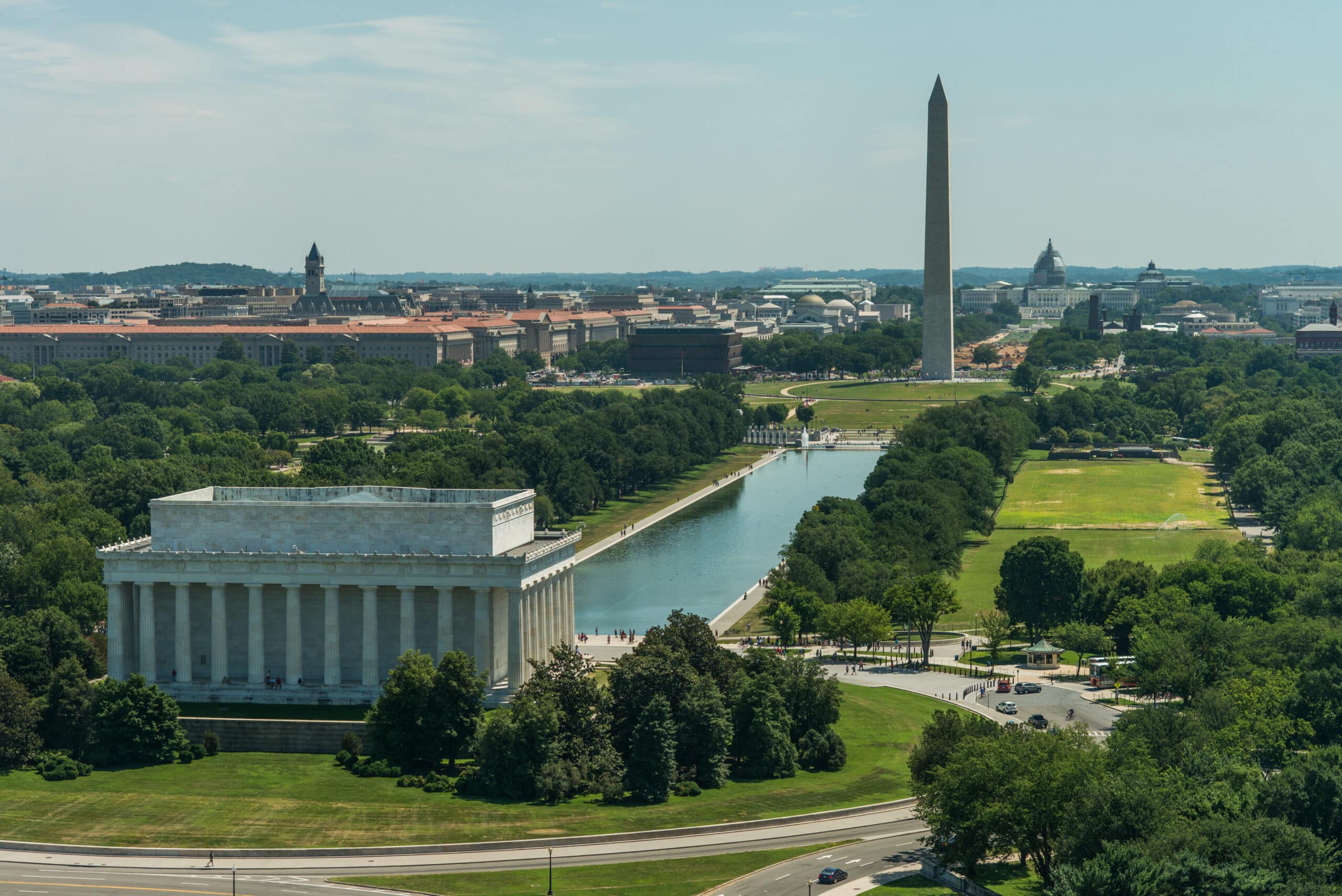
D.C. is a far greener city than most visitors expect. From the 1,800 acres of Rock Creek Park to the cherry-blossom-lined Tidal Basin and the grand open sweep of the National Mall, the city’s outdoor spaces are as much a part of the experience as its monuments and museums.
Washington D.C. was designed with open space in mind, and the result is a city where nature is genuinely woven into the urban fabric. Pierre Charles L’Enfant’s original plan embedded parks, circles, and green corridors throughout the street grid, and the result — more than two centuries later — is a city where you’re rarely more than a few minutes from somewhere worth sitting outside.
The National Mall is the most famous of these spaces, but it’s just the beginning. Rock Creek Park is one of the largest urban parks in the United States. The Tidal Basin offers one of the most beautiful short walks in any American city. The National Arboretum spreads across 446 acres of trees, gardens, and extraordinary seasonal color. For visitors staying in D.C.’s residential neighborhoods, the city’s parks aren’t just scenic destinations — they’re part of daily life.
The 1.9-mile open corridor stretching from the Lincoln Memorial to the U.S. Capitol is the symbolic heart of Washington and one of the great public spaces in the world. Flanked by the Smithsonian museums and anchored by the Washington Monument at its center, the Mall is simultaneously a park, a gathering place, a protest ground, and a living monument to American civic life. Joggers and dog walkers share it at 6am with tourists at noon and free concert audiences in the evening. It is never the same place twice, and it is always worth visiting again.
Rock Creek Park is one of the oldest and largest urban national parks in the United States — 1,800 acres of forested valley running through the heart of northwest D.C. from the Maryland border to the Potomac. Residents use it as their backyard: hiking and mountain biking on miles of unpaved trails, running the paved Beach Drive corridor (closed to cars on weekends), picnicking at the many designated areas, and visiting the 1820 Peirce Mill, a working grist mill that is one of D.C.’s quietest historic sites. The park changes dramatically by season — lush in summer, spectacularly golden in October, serene under winter snow.
The 107-acre reservoir connecting the Potomac to the Washington Channel is lined with nearly 3,000 cherry trees — Japan’s gift to the United States in 1912 — and is the setting for D.C.’s most celebrated annual spectacle. But the Tidal Basin is worth visiting in every season. The 2-mile walk around its perimeter passes the Jefferson and MLK memorials, offers some of the finest views in the city, and connects to East Potomac Park beyond. Paddleboats are available for rent from March through October. At first light on a still morning, the Basin perfectly reflects the Jefferson Memorial dome in a way that photographs can barely capture.
Four hundred and forty-six acres of gardens, forests, and collections in northeast D.C. — one of the city’s best-kept secrets and consistently one of its most beautiful destinations. The Arboretum is administered by the USDA and specializes in research collections, which means visitors encounter unusual species and extraordinary plantings across a landscape that feels genuinely wild in places. The 22 original Corinthian columns from the U.S. Capitol — removed during renovations in 1958 and relocated here — stand in an open meadow in a way that is both strange and magnificent. Fall foliage here rivals anything in New England.
The 10-acre formal garden attached to the historic Dumbarton Oaks estate in Georgetown is arguably the most beautiful garden in Washington — a series of terraced outdoor rooms descending a hillside, designed by landscape architect Beatrix Farrand in the 1920s and maintained to an extraordinary standard. The rose garden, the swimming pool terrace, the wisteria arbor, the kitchen garden — each is a separate discovery. The adjacent Dumbarton Oaks Park, run by the National Park Service, is free and extends the experience into wilder woodland beyond the formal gates.
One of the finest examples of formal park design in the United States and a beloved neighborhood gathering place in Columbia Heights. Meridian Hill Park’s lower section features a cascading 13-basin water staircase — one of the longest in the country — flanked by terraced walls and fountains. The upper level is a long formal lawn with dramatic views south toward the Washington Monument. On Sunday afternoons the park hosts a long-running drum circle that has been a D.C. institution for decades. It’s a locals’ park in a way that the Mall is not, and it rewards visitors willing to walk a few blocks from the Metro.
The only national park in the country dedicated to aquatic plants, Kenilworth is one of D.C.’s most unexpected natural treasures. Dozens of ponds filled with native and exotic water lilies and lotuses bloom from July through September in a setting that feels more Southeast Asian than mid-Atlantic. The lotus peak — usually late July to mid-August — is a genuine phenomenon. The surrounding Kenilworth Marsh is one of the last tidal marshes remaining in D.C., home to osprey, great blue herons, and river otters. It is quiet, utterly removed from the tourist circuit, and one of the city’s great outdoor secrets.
A 91-acre forested island in the Potomac River, accessible only by a pedestrian bridge from the Virginia shore, Theodore Roosevelt Island feels more like a mountain hike than a D.C. park visit. Two and a half miles of wooded trails wind through marsh, swamp, and upland forest around a central plaza with a 17-foot bronze statue of Roosevelt. The island is genuinely wild — a refuge for woodpeckers, bald eagles, and river otters within sight of the Kennedy Center. For those staying in Georgetown or Dupont, it’s a 20-minute walk across Key Bridge and into a different world entirely.
Practical guidance for enjoying the city outdoors, season by season.
Local knowledge for getting the most out of D.C.’s outdoor spaces.
The Tidal Basin at 6am during cherry blossom season is transformative. The crowds are minimal, the light is extraordinary, and the reflection of the Jefferson Memorial in still water is one of the great photographic moments in American travel. Set the alarm.
Beach Drive in Rock Creek Park is closed to cars on weekends. From Saturday morning to Sunday evening, a stretch of the park’s main road becomes a cycling and pedestrian corridor — one of D.C.’s finest weekend activities and almost entirely unknown to visitors.
Kenilworth Aquatic Gardens is genuinely unknown. Most D.C. visitors never hear of it. In late July, hundreds of lotus blooms rise above the ponds in a setting unlike anything else in the region. If you’re in D.C. in summer, it’s worth the trip to northeast.
The National Arboretum Capitol Columns are one of D.C.’s strangest sights. Twenty-two original sandstone columns from the U.S. Capitol, removed during renovations, stand in an open meadow at the Arboretum like a classical ruin. Nobody talks about them. They are extraordinary.
Meridian Hill Park’s Sunday drum circle has been happening for over 50 years. It begins around 3pm and continues until dark. It’s participatory, joyful, and entirely free — one of those D.C. experiences that doesn’t appear in any guidebook but that residents consider essential.
Our neighborhoods have their own green spaces. Lincoln Park on Capitol Hill, Logan Circle itself, Dupont Circle’s park — the city’s residential circles and squares are small but genuinely lovely, and the best way to experience them is to stay in the neighborhood long enough to use them like a local.
We’ve been placing guests in D.C.’s most livable neighborhoods for fifteen years, and what surprises visitors most — consistently — is how green the city feels. Shaw has a pocket park on nearly every block. Capitol Hill has Lincoln Park, a neighborhood square that residents treat like a backyard. Logan Circle’s park fills with locals every evening in good weather. The city’s outdoor life isn’t just about the Mall and the monuments — it’s woven into the neighborhoods in a way that reveals itself gradually, over the course of a stay. That’s one of the things a vacation rental makes possible that a hotel doesn’t.
Stay in a neighborhood with a park on the doorstep.
Our properties in Shaw, Logan Circle, Capitol Hill, and Dupont Circle put you in D.C.’s greenest, most walkable neighborhoods — the best base for exploring the city’s outdoor spaces.