


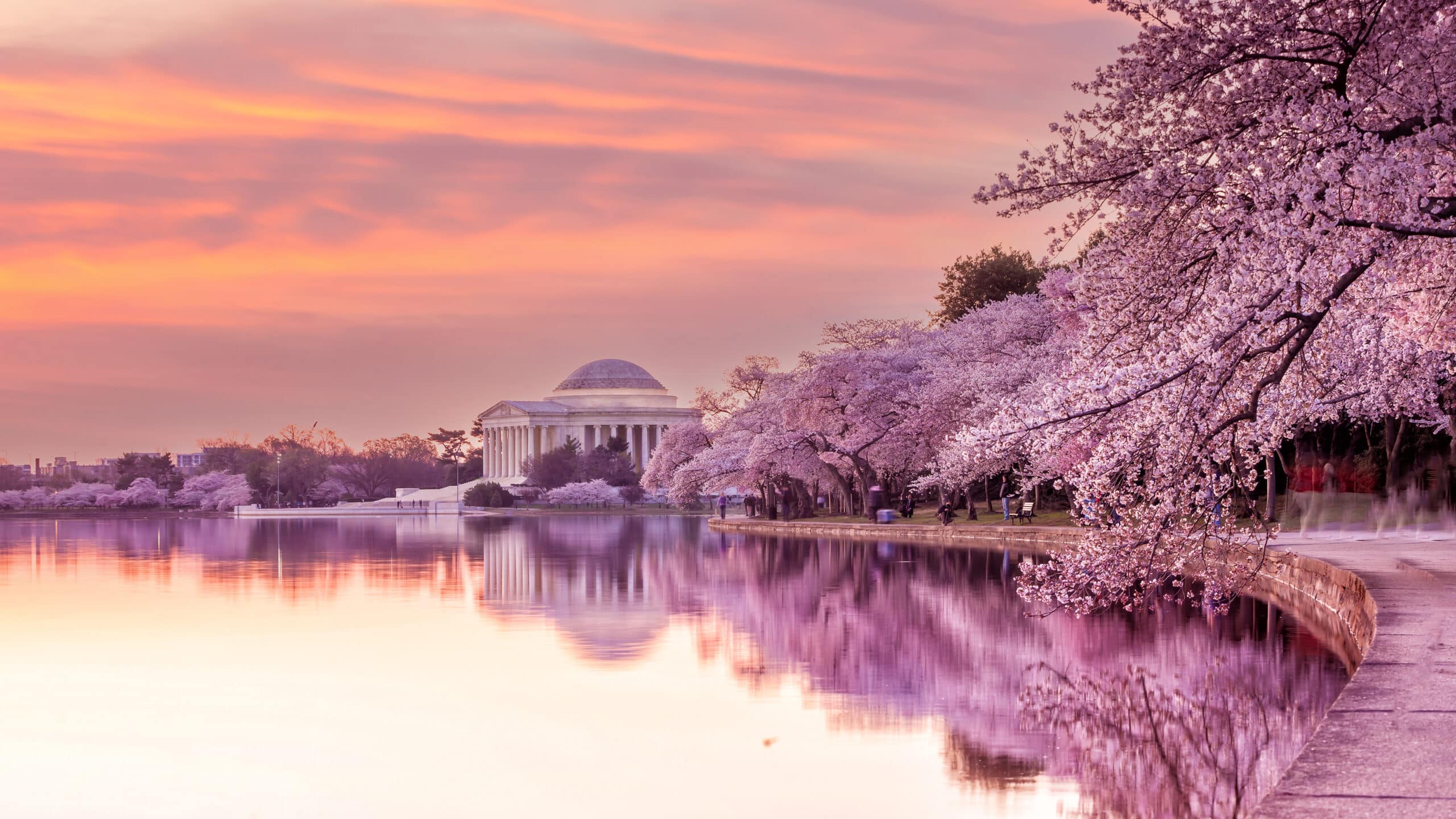
D.C. is a city that lives by the calendar. Cherry blossoms in spring, fireworks over the Capitol on the Fourth of July, jazz on the waterfront in early fall, holiday markets in December. The events that define each season here are genuinely worth planning a trip around.
Washington D.C. has a richer seasonal event calendar than its reputation as a political capital might suggest. The cherry blossom festival draws over a million visitors each spring for good reason. July 4th on the National Mall is one of the great civic spectacles in American life. The DC JazzFest transforms the Wharf waterfront each September. The holiday season brings a National Christmas Tree, outdoor markets, and ZooLights at the National Zoo. Each season has its signature moments, and knowing what’s on when can shape a trip in ways that the monuments and museums alone cannot.
This page covers the recurring annual events worth knowing about. Dates shift slightly year to year, so we’ve noted typical timing rather than specific dates. Check the linked websites for current schedules before finalizing any trip.
D.C.’s most iconic annual event and one of the great spring spectacles in America. Nearly 3,000 cherry trees planted around the Tidal Basin bloom for a brief window each year, drawing over a million visitors. The festival spans three to four weeks and includes the Blossom Kite Festival on the Mall, the Opening Ceremony at the Warner Theatre, a parade down Constitution Avenue, and free outdoor events throughout the city. Peak bloom typically lasts only four to six days, so timing matters. Book accommodation at least two months in advance for peak bloom weekends.
An official event of the Cherry Blossom Festival held on the grounds of the Washington Monument, the Blossom Kite Festival invites families to fly kites on the Mall with the cherry blossoms as a backdrop. Kite-making workshops, live Taiko drumming, and competitions for all skill levels make it one of D.C.’s most genuinely joyful annual gatherings. Free to attend, stroller-friendly, and one of those events that children remember long after the trip ends.
The oldest annual event on White House grounds and one of the most sought-after tickets in D.C. Held on the South Lawn on Easter Monday, the Egg Roll features egg rolling, live entertainment, storytelling, sports activities, and visits from the Easter Bunny. Free tickets are distributed by lottery through the White House website, usually in the weeks before Easter. Demand is extremely high — enter the lottery as soon as it opens if attending is a priority.
A nationally televised concert held on the West Lawn of the U.S. Capitol on the Sunday evening before Memorial Day. Broadcast live on PBS, the concert honors America’s fallen servicemembers through orchestral music, choral performances, and dramatic readings by celebrity hosts. The event is free to attend in person with no ticket required, and the combination of the Capitol backdrop, candlelight, and patriotic programming makes it one of the most moving annual events on the Mall.
One of the largest and most distinctive cultural festivals in the world, held annually on the National Mall since 1967. The Folklife Festival typically runs for two weekends straddling the Fourth of July and features living cultural traditions from several featured regions or themes, with performers, artisans, cooks, and musicians presenting their work in an open, participatory format. Visitors can taste food, try crafts, ask questions, and engage directly with tradition bearers from across the U.S. and around the world. Entirely free, family-friendly, and unlike any other event in the city.
The National Symphony Orchestra performs on the West Lawn of the U.S. Capitol in front of hundreds of thousands of spectators, broadcast live on PBS nationwide. The evening concert culminates in one of the largest fireworks displays in the country, launched from the Mall with the Washington Monument, Lincoln Memorial, and Capitol as backdrops. Gates open at 3pm and the concert begins at 8pm. No tickets required. Arrive by mid-afternoon to secure a good position. One of the great civic events in American public life.
The Millennium Stage program operates year-round, but summer is when it is most worth building an evening around. Every day at 6pm, a free public performance takes place in the Grand Foyer of the Kennedy Center. Summer programming frequently includes world music, jazz, and dance forms that feel especially alive in the warmer months. After the show, the terrace above the Potomac offers one of the finest sunset views in the city with no admission or reservation required.
Each June, the Shakespeare Theatre Company presents a free outdoor Shakespeare production at Sidney Harman Hall, with free tickets distributed in advance and on a first-come basis. The Free For All is one of D.C.’s most generous civic cultural traditions, drawing thousands of theatregoers who might not otherwise attend a professional Shakespeare production. Tickets go quickly, particularly for weekend performances. Check shakespearetheatre.org for the current year’s production and ticket distribution schedule.
One of the premier jazz festivals on the East Coast, DC JazzFest runs for five days in early September with the main concerts held at The Wharf’s outdoor stages overlooking the Potomac. The festival blends jazz, blues, swing, soul, and Latin influences, featuring a mix of world-renowned artists and strong local talent. Many events are free, with ticketed headline performances in the evenings. The Wharf setting, with its waterfront restaurants and bars, makes the festival an exceptional evening out even beyond the music itself.
One of the city’s oldest and most beloved neighborhood festivals, Adams Morgan Day transforms 18th Street into a celebration of one of D.C.’s most culturally diverse neighborhoods. Live music on multiple stages, international food vendors, local artisans, and a crowd that genuinely reflects the neighborhood’s character make this one of the most enjoyable free events of the year. It’s also the best argument for spending an evening in Adams Morgan: the restaurants and bars that line the street are in full swing, and the festival energy carries well into the night.
Known as “The People’s Marathon,” the Marine Corps Marathon is one of the largest marathons in the world and one of the most spectacular to spectate. The 26.2-mile route passes the Lincoln and Jefferson Memorials, the Washington Monument, Georgetown, and the Pentagon before finishing at the Iwo Jima Memorial in Arlington. The combination of the course’s scenery and the Marine Corps’ involvement in organizing and finishing ceremonies makes this an extraordinary event even for non-runners. Many of the best spectating spots are near HSC properties in Capitol Hill and Logan Circle.
Veterans Day in Washington carries a weight it has nowhere else. The ceremonies at Arlington National Cemetery, the Vietnam Veterans Memorial, the World War II Memorial, and the Korean War Veterans Memorial draw families of servicemembers from across the country. The Tomb of the Unknown Soldier wreath-laying ceremony at Arlington is one of the most solemn and moving public events in America and is free to witness. Check the National Park Service and Arlington National Cemetery websites for ceremony times and any access requirements.
Georgetown goes all-in on Halloween, and the neighborhood’s 18th-century streets and Federal rowhouses make for one of the most atmospheric trick-or-treating environments in the country. The blocks around 31st and Q Streets are known for extraordinary house decorations, and families come from across the city for the evening. The Georgetown Ghost Tour, run by DC by Foot, leads walkers through the neighborhood’s ghost stories and strange history, ending at the famous Exorcist Steps at 36th and Prospect, where a free haunted light show runs on Halloween night. One of D.C.’s most spirited evenings, in every sense.
NoMa’s annual Halloween celebration transforms Alethia Tanner Park into a free community festival with live entertainment, a seasonal scavenger hunt, food, music, and a pick-your-own pumpkin patch that draws families from across the city. PumpkinPalooza is one of D.C.’s most genuinely joyful fall events and entirely free to attend. A natural complement to an afternoon at Union Market nearby, and one of the better free family outings the season offers.
The National Christmas Tree on the Ellipse just south of the White House is lit in a ceremony each year in early December, with a free ticketed live music event that typically draws major performers. The tree remains illuminated through early January, and the surrounding Pathway of Peace — a display of 56 smaller trees representing each state and territory — is accessible free of charge around the clock. A walk around the Ellipse on a clear winter evening, with the White House behind you and the tree lit ahead, is one of Washington’s most quietly memorable seasonal experiences.
ZooLights transforms the National Zoo each holiday season into an illuminated evening experience with over half a million LED lights across the animal habitats and pathways. Fire pits, seasonal food and drink, themed displays, and the unique combination of a zoo setting and winter evening lighting make it one of D.C.’s most popular family events. Tickets are required and sell out well in advance, particularly on weekend evenings. Book as early as possible through nationalzoo.si.edu.
One of the best holiday markets in America, held in Penn Quarter at F Street NW between 7th and 9th Streets for several weeks before Christmas. Around 70 vendors offer handmade goods, gifts, food, and mulled wine in an outdoor market that genuinely captures the European market atmosphere without the kitsch. Free to browse, walkable from multiple Metro stations, and an ideal destination after an evening at one of the Penn Quarter theaters. Evenings on weekends are busy; weekday afternoons are the most relaxed.
The outdoor ice rink in the National Gallery of Art Sculpture Garden is one of the finest skating venues in the city, set among major works of 20th-century sculpture with the Capitol dome visible in the distance. Skate rental is available on-site. Friday evenings feature live DJ music. The rink is smaller and more charming than commercial rinks, the setting is extraordinary, and combining an afternoon skate with a visit to the National Gallery or a walk along the Mall makes for one of D.C.’s best winter afternoons. Check nga.gov for operating hours and skate rental details.
How to make the most of D.C.’s seasonal events.
Cherry blossom timing is unpredictable. Peak bloom shifts by one to two weeks year to year. Monitor the National Park Service bloom forecast, which is updated regularly from late February. The bloom lasts only four to six days at peak, so flexibility helps.
Book accommodation months ahead for peak events. Cherry blossom season and the July 4th weekend are the two periods when D.C. accommodation is most constrained. A vacation rental booked three to four months out is significantly better value than a hotel booked last-minute.
Many of the best events are entirely free. The Fourth of July concert and fireworks, the Folklife Festival, the Memorial Day Concert, the Christmas Tree, the Millennium Stage, and the Marine Corps Marathon spectating cost nothing. D.C.’s event calendar is unusually generous.
Arrive early for outdoor events on the Mall. For the Fourth of July and the Blossom Kite Festival particularly, arriving two to three hours early secures a good position. The Mall fills fast and the experience degrades significantly in a large crowd without a clear sightline.
Fall is the most underrated season for events. DC JazzFest, Adams Morgan Day, and the Marine Corps Marathon all fall in September and October, when the weather is often perfect and crowds are smaller than spring or summer.
Check washington.org for the complete calendar. The Washington DC tourism office maintains a comprehensive and up-to-date events calendar at washington.org that covers everything from major festivals to neighborhood events, free performances, and one-off exhibitions.
The guests who enjoy D.C. most tend to have thought about timing before they booked. A trip that coincides with cherry blossom peak bloom, the Folklife Festival, or the JazzFest is a different trip to one that happens to land in the same city on an ordinary weekend. None of that requires elaborate planning, just a quick look at the calendar before choosing dates. If you have flexibility, the answer is often late September or October: the weather is usually excellent, the fall color in Rock Creek Park and the National Arboretum is genuine, the summer crowds have thinned, and DC JazzFest and Adams Morgan Day both fall within a few weeks of each other. It is consistently the city’s most underrated time of year.
Plan your visit around what matters.
Our properties book up during peak events, particularly cherry blossom season and the Fourth of July. Secure your dates early and we’ll help with the rest.